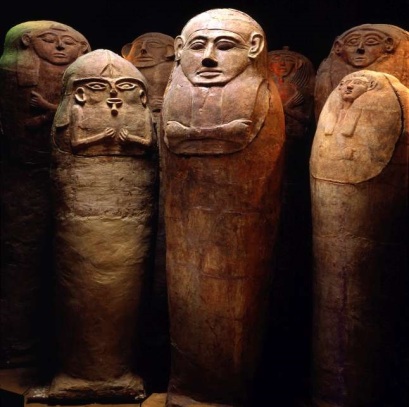
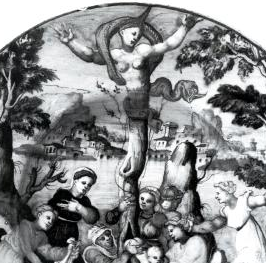
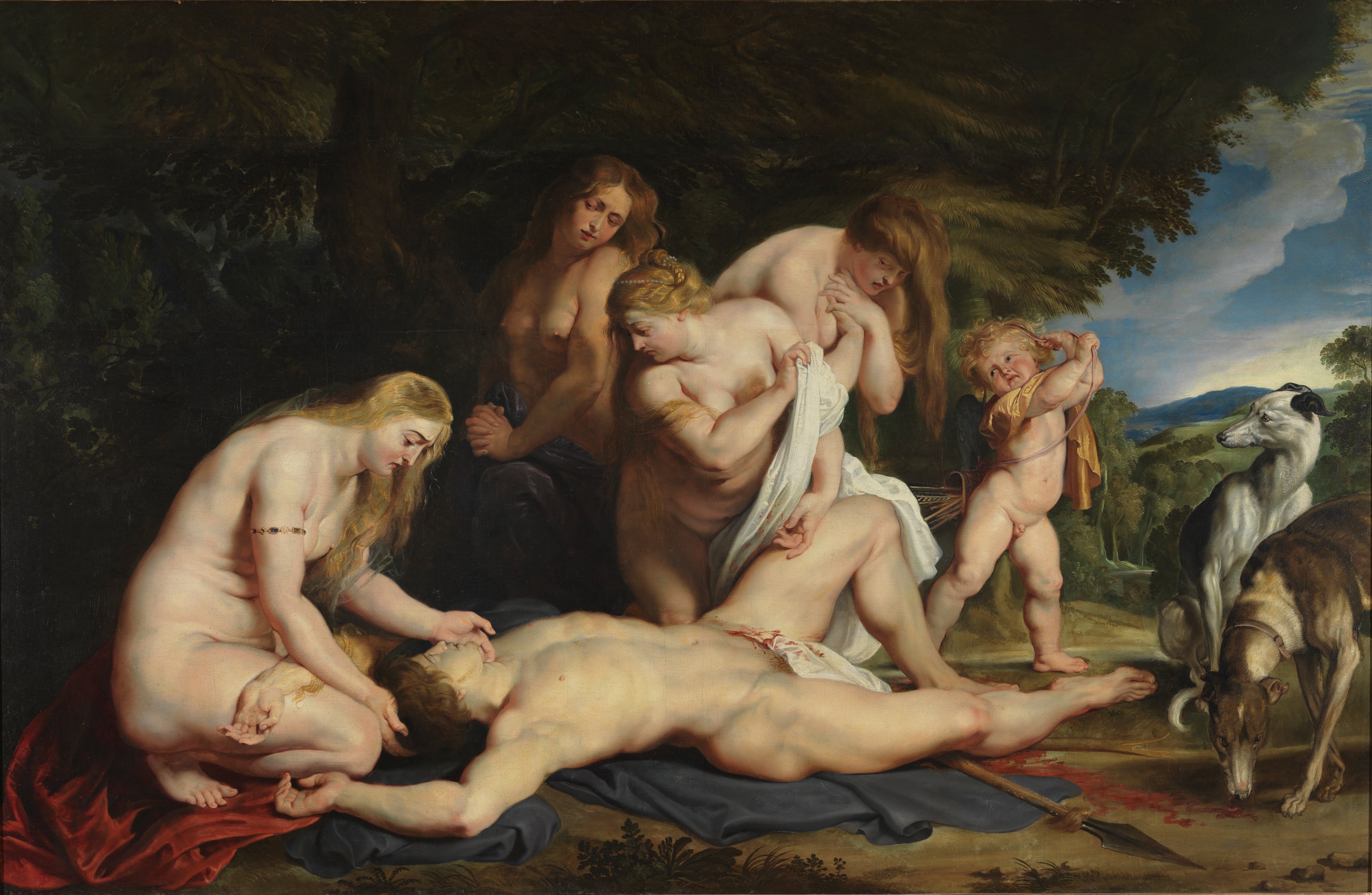
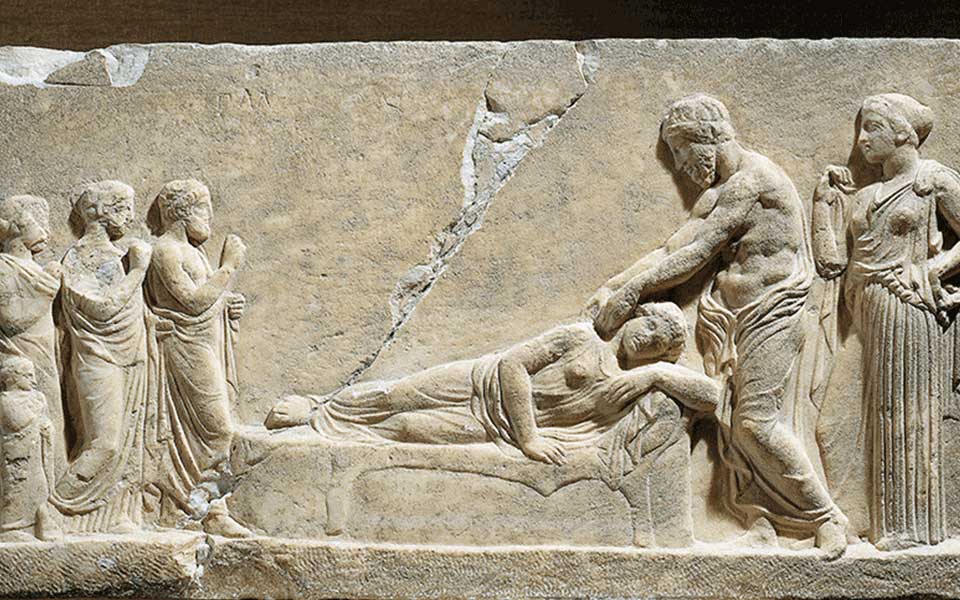
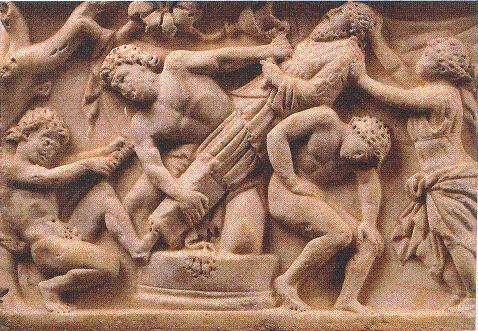
About 10,000 years ago, the last Ice Age came to an end, resulting in the northward migration of wild game that hunter-gatherers had depended upon since time immemorial. In response, man came to settle along the banks of seas and rivers, where they took up fishing and agriculture in order to maintain sustenance. As agriculture became an essential function of both civilization and subsistence, it also became crucial to understand the nature of the seasons and the solar cycles that contribute to seasonal change. Since the scientific method had yet to be conceived, we came to understand the sun and the seasons through ritual and myth—particularly the personification of croplife. From this sprang dying and rising god myths, symbolizing the death and return of vegetation, the waxing and waning of the sun, etc.
Over time, man came to believe that performing certain rituals of initiation could mystically unite him with the fate of the risen god, affecting for him a spiritual rebirth in this life, and, ultimately, a blessed existence in the next. The origins of this soteriology, at least insofar as the earliest evidence shows, appear to lie in the ancient Egyptian cult of Osiris. As one risen from the dead, Osiris became the conduit through which all ancient Egyptians could rise to eternal life, via a process of imitative magic or ritual assimilation with the god.
Similar concepts of salvation began to arise in the Greco-Roman world after Alexander the Great inaugurated the Hellenistic Age—a time of unprecedented sharing of ideas between formerly disparate cultures, resulting in rampant religious syncretism. The salvific components of the Osirian cult appear to have found their way into the various “mysteries” of Dionysus, Attis, Adonis, etc. Not least among these was Christianity. The inherent mysticism by which the devotee ritually shares in the death and resurrection of the god is featured in such passages as Rom. 6:3-5 and Col. 2:12, where baptismal initiation of the Christian neophyte brings about his metaphorical death and rebirth, culminating in a resurrection to eternal life (1 Cor. 15:20-22).
Critical scholars of ancient religion and Christian origins have long recognized the proverbial strands of mystery religion “DNA” in the New Testament. However, evangelical scholars and apologists, who still exert a massive influence within academia, have fought mightily to distance Christianity from its pagan predecessors. Any external influences are considered a threat to the notion that the Bible is exclusively a product of divine revelation, unsullied by the impure and mundane imaginations of man.
There is perhaps no more comprehensive a case against Christianity’s indebtedness to the ancient mysteries than that found in Dr. Ronald Nash’s 1994 article for the Christian Research Journal.[i] Many apologists appeal to this work, carting out a list of Nash’s primary contentions against pagan influences upon Christianity—a list which represents the standard objections raised by nearly all apologists. I shall consolidate this list into the nine essential arguments proffered by Nash, addressing each in turn.
(1) Arguments offered to “prove” a Christian dependence on the mysteries illustrate the logical fallacy of false cause. This fallacy is committed whenever someone reasons that just because two things exist side by side, one of them must have caused the other. As we all should know, mere coincidence does not prove causal connection. Nor does similarity prove dependence.
Here, Nash is attempting to accuse scholars of comparative religion of the fallacy known as cum hoc ergo propter hoc, which states that correlation is not causation. However, the fallacy would be better stated, “Correlation is not necessarily causation.” Oftentimes, correlations exist precisely because of causation, which is why the fallacy exists to begin with, since we have a tendency to over-infer causation based on the general rule.
As it concerns this case, if scholars of comparative religion were going merely on superficial similarities, positing dependence might well constitute such a fallacy. But, there’s a far greater cumulative case at hand: primarily, the soteriological similarities (the homologic principle, or imitatio dei, whereby the devotee mystically shares in the god’s death and resurrection); the rampant use of mystery cult terminology employed by Paul (e.g. mysterion, meaning “mystery” or “secret,” and teleios, denoting “perfection” or “maturity,” all of which held the same religious connotation in the mysteries); the agricultural symbolism involving the death of the planted seed as invoked by the NT authors (1 Cor. 15:35-37; John 12:24, etc.); the likely influence of the Hellenistic mysteries upon Paul and other Hellenized Jews in the Diaspora, and the fact that Christianity ultimately arose from a heavily syncretistic milieu in which the mysteries had reached the height of their popularity. It is also worth noting that the parallel interaction between deity and devotee, i.e., dying and rising in mystical unison, has no basis whatsoever in Judaism, but was certainly prevalent in the mysteries, whence it must have been derived.
Thus, the fallacy here is all Nash’s. He has committed a strawman argument by misrepresenting why it is that critical scholars see a connection between Christianity and the mystery religions. It is most decidedly not because of mere, historical coexistence or superficial similarities.
(2) Many alleged similarities between Christianity and the mysteries are either greatly exaggerated or fabricated. Scholars often describe pagan rituals in language they borrow from Christianity. The careless use of language could lead one to speak of a “Last Supper” in Mithraism or a “baptism” in the cult of Isis. It is inexcusable nonsense to take the word “savior” with all of its New Testament connotations and apply it to Osiris or Attis as though they were savior-gods in any similar sense.
No, it is inexcusable nonsense to claim that Christianity has some kind of trademark on words and phrases that are just as apt for describing the mysteries as they are for describing Christianity. For example, Nash suggests the use of the word “resuscitation” for the mystery gods, though “resurrection” is far more appropriate, since the former implies restoration from unconsciousness, from the cessation of breathing, or from a mere “apparent” death, whereas ”resurrection” more aptly describes a restoration from a state of absolute death to life, which applies equally to Jesus, Osiris, Dionysus, et al. Nash is merely engaging in special pleading for exclusive ownership of his favored vocabulary, in a desperate attempt to distance Christianity as much as possible from legitimate and noteworthy similarities in the pagan cults.
Nash’s assertion that the word “savior” carries a misleading connotation in reference to the mystery gods is sheer nonsense. All of these figures were essentially saviors. Whether through Jesus Christ or the Egyptian Osiris, one was saved from the cessation of existence, from damnation, whether at the hands of Ammit or Eternal Hellfire, and given the gift of eternal life. In the Hellenistic mysteries, especially, one could attain rebirth already in this life, just as Christian baptism achieves for its initiates.
(3) The chronology is all wrong. Almost all of our sources of information about the pagan religions alleged to have influenced early Christianity are dated very late. We frequently find writers quoting from documents written 300 years later than Paul in efforts to produce ideas that allegedly influenced Paul. We must reject the assumption that just because a cult had a certain belief or practice in the third or fourth century after Christ, it therefore had the same belief or practice in the first century.
First, as Dr. Robert M. Price notes, “It is a fundamental methodological error to assume that a phenomenon must have arisen just shortly before its earliest attestation.”[ii] Besides, this is an egregious error on Nash’s part. We have a multitude of highly informative, pre-Christian and contemporary sources on the mysteries—from ancient pyramidal texts (circa 2600 BCE) to the testimony of such historic figures as Hesiod, Pindar, Sophocles, Herodotus, Plato, Livy, Diodorus Siculus, Julius Caesar, and Plutarch, all of which range from the 8th century BCE to the 1st century CE. Not to mention, ancient burial inscriptions, artifacts, and frescoes. Nash is either woefully ignorant of the facts or lying outright.
No doubt, we get a fuller picture of mystery cult practices in the 2nd-4th centuries CE, but this is to be expected. The mysteries, as their namesake implies, held secrecy in the highest regard; therefore, not until the spread of Christianity do we receive antagonistic commentary from early church fathers, providing the bulk of extant evidence. There would likely be a great deal more evidence had it not been for the destructive decrees against paganism by Emperor Theodosius in the 4th century CE.
Nevertheless, we can easily reconstruct the general practices and beliefs of the mystery religions from the collection of both pre- and post-Christian sources, which correspond with each other quite well—in particular, Apuleius’ Metamorphoses (2nd C. CE) and the sacred texts of ancient Egyptian pyramids and burial inscriptions, which indicate that the salvific components of the Hellenistic mysteries have their conceptual roots in the cult of Osiris, dating as far back as the 3rd millennium BCE. In both Apuleius’ account of the mysteries and the coffin texts of ancient Egypt, the mystes is identified with Osiris in death, resulting in new life—whether in this life or the next.[iii]
(4) Paul would never have consciously borrowed from the pagan religions. All of our information about him makes it highly unlikely that he was in any sense influenced by pagan sources. He placed great emphasis on his early training in a strict form of Judaism (Phil. 3:5). He warned the Colossians against the very sort of influence that advocates of Christian syncretism have attributed to him, namely, letting their minds be captured by alien speculations (Col. 2:8).
Quite to the contrary, all of our information concerning Paul makes it highly likely that he was influenced by pagan sources, particularly the mysteries. There is, according to Acts 9:11, his upbringing in Tarsus, an ancient city that rivaled both Athens and Alexandria in Hellenistic, intellectual culture during Paul’s day, not to mention a major cult site of the mystery god Attis, as revealed by archaeological finds from the 1st century BCE. There is, again, the rampant use of mystery cult terminology employed by Paul, as well as the invocation of agricultural symbolism, such as the death of the planted seed and its sprouting to new life. What’s more, Paul’s rhetoric and theology correspond precisely to that of the Hellenized Jew, Philo of Alexandria, who also spoke of a firstborn son of God, who was the very “image of God” and God’s “agent of creation” (Conf. 62-63, 146-47; cf. Ro. 8:29; 2 Cor. 4:4; 1 Cor. 8:6), able to “procure forgiveness of sins” (Mos. 2.134; cf. Ro. 3:23-24). These ideas represent a syncretism of Jewish and Middle Platonic religiosity, i.e., Hellenistic “paganism.”
Most importantly, there is the mystery religion soteriology revealed by such passages as Romans 6:3-5, Philippians 3:10-11, 1 Corinthians 15:20-22, etc. This is truly the most salient point, as it goes to show that Paul went well beyond the mere use of similar words and phrases to describe the Christian mystery; he incorporated the very mysticism—the underlying salvation scheme—of the Hellenistic mystery cults, whereby the newly initiated sacramentally shared in the death and resurrection of the god.
And there’s no use suggesting that Jews from the period would never have succumbed to Hellenistic paganism. 2nd Maccabees informs us that they were forced to engage in Dionysus worship, which may have had lasting consequences, as attested by Plutarch and Tacitus. It also laments “an extreme of Hellenization and increase in the adoption of foreign ways” (4:13). The Dead Sea Scrolls reveal the Jewish embrace of Hellenistic astrology, which comports with horoscopes found at Qumran.[iv] And Philo of Alexandria was pontificating on Hellenistic religious concepts like rebirth and immortality of the soul—in a disembodied state no less—during the first half of the first century (Cher. 113). Esoteric Jewish movements such as the Essenes and Therapeutae also embraced this Hellenized style of immortality (Cont. 68). While many zealous and conservative Jews resisted Hellenistic culture, others simply did not, as the evidence clearly shows.
(5) Early Christianity was an exclusivistic faith. As J. Machen explains, the mystery cults were nonexclusive. “A man could become initiated into the mysteries of Isis or Mithras without at all giving up his former beliefs; but if he were to be received into the Church, according to the preaching of Paul, he must forsake all other Saviors for the Lord Jesus Christ … Amid the prevailing syncretism of the Greco-Roman world, the religion of Paul, with the religion of Israel, stands absolutely alone.” This Christian exclusivism should be a starting point for all reflection about the possible relations between Christianity and its pagan competitors. Any hint of syncretism in the New Testament would have caused immediate controversy.
Indeed, Christian exclusivism is a starting point for such reflection, and possibly a damning concluding point, to boot. As Price explains in Deconstructing Jesus, “previous converts to the inclusivistic faiths of Mithras, Attis, Isis or Dionysus would have come pouring into the ‘open gates’ of Christianity, bringing all of their cherished beliefs with them,” and thus “we would be amazed not to find a free flow of older ‘pagan’ myths and rituals into Christianity.” Despite the exclusion of “other faiths as rivals and counterfeits of Christianity … the barn door was, as usual, shut after the horse had got out (or rather, in!).”[v] Nash has inadvertently engaged a premise that produces the exact opposite of its intended effect, arguing for a position that makes Christian syncretism with the pagan mysteries all the more viable.
(6) Unlike the mysteries, the religion of Paul was grounded on events that actually happened in history. The mysticism of the mystery cults was essentially nonhistorical. Their myths were dramas, or pictures, of what the initiate went through, not real historical events, as Paul regarded Christ’s death and resurrection to be. The Christian affirmation that the death and resurrection of Christ happened to a historical person at a particular time and place has absolutely no parallel in any pagan mystery religion … [This] makes absurd any attempt to derive this belief from the mythical, nonhistorical stories of the pagan cults.
To begin with, Nash is begging the question by presuming that Paul’s Christianity, the earliest form we know of, concerns recent events in mundane history. Paul gives no historical context whatsoever for Christ’s crucifixion, but places the blame on the archons and aions, the demonic rulers of this age (1 Cor. 2:8), much like the apocryphal Ascension of Isaiah, where Satan and his angels crucify him prior to his celestial resurrection (9.14). Whether Paul even considered Jesus to have been a recent, historical person is highly debatable. As mentioned above, Paul’s Christ Jesus appears to be an analogue to Philo’s firstborn son of God, a lofty, celestial deity of whom Paul knows only through scripture and revelation (1 Cor. 15:3-4; Gal. 1:11-12), not from any recent, historical source. Even where Paul declares that Jesus was “born of a woman” (Gal. 4:4) and descended from David (Ro. 1:3), he is relying on scriptural pesher, not historical data. And, though Galatians 1:19 mentions a James, “the brother of the Lord,” Paul is using an epithet that was bestowed upon all baptized Christians (1 Cor. 15:1; Phil. 1:14), not a description of an earthly sibling. There is simply nothing of biographical value in Paul’s letters—nothing evincing a recent, historical man, but, rather, a syncretistic confluence of dying and rising gods, Hellenistic heroes, Zoroastrian eschatology, and Greco-Judaic, philosophical prototypes.
But let’s just say, for the sake of argument, that Jesus was a historical person, put to death on the cross under Pontius Pilate as the later Gospels suggest. Even if that were the case, Nash is still foisting a completely dubious non-sequitur. The cognate myths of the mystery religions needn’t have been considered recent, historical events in order to inspire the salvific significance attached to the “historical death and resurrection” of Jesus. Rudolf Bultmann, Geza Vermes, S.G.F. Brandon, Samuel Sandmel, Hyam Maccoby, Richard Reitzenstein, and Marvin Meyer are among many scholars who have understood, perfectly well, that a historically crucified, messianic hopeful could have easily spawned an apocalyptic Jewish movement that, upon Hellenistic soil, absorbed popular mystery cult accoutrements. And besides, as Price explains, “all of these religions thought their saving events happened in some vague and special past. In Crete they presented the tomb of Zeus, killed by a boar yet resurrected.”
(7) Jesus died once and for all (Heb. 7:27; 9:25-28; 10:10-14). In contrast, the mystery gods were vegetation deities whose repeated deaths and resuscitations depict the annual cycle of nature.
A half-truth. Tammuz, Persephone, and Adonis were conceived as undergoing a cyclical journey from the underworld (death) to the land of the living, and so on and so forth. In contrast, the myths of Aleyan Baal, Ishtar, Osiris, Dionysus-Zagreus, and Attis featured a one-time death and resurrection motif, just as that of Christ. Their resurrections may have been celebrated annually, but in a manner no different than Easter is celebrated today. And, that their deaths and resurrections symbolized the annual cycle of nature is another half-truth. They were originally personifications of the death and rebirth of croplife; but, as time went on, they came to represent the hope and yearning of all individual devotees for an immortality like that achieved by their god.[vi]
(8) None of the so-called savior-gods died for someone else. Only Jesus died for sin. As Gunter Wagner observes, to none of the pagan gods “has the intention of helping men been attributed. The sort of death that they died is quite different (hunting accident, self-emasculation, etc.).”
This is not entirely accurate, as Plato informs us that “expiations and atonements for sin” were indeed a component of the mysteries (Rep. 2.7). Though, how widely this applied to the various mystery cults of the ancient world cannot be known, as there is scant evidence for it elsewhere. Regardless, Nash’s argument is irrelevant. Christianity is essentially a syncretism of Judaism and Hellenistic mystery religions, a Greco-Judaic hybrid. As such, we should expect to find Jewish elements, e.g., vicarious sacrifice and atonement for sin, that might be absent from the mysteries. Likewise, we should also expect to find mystery religion elements, e.g., sacramental participation in the death and resurrection of the god, and symbolic consumption of the deity’s flesh and blood, that are wholly absent from, and even anathema to, Judaism.
As to the specific circumstances of their deaths, that is equally irrelevant, as syncretism entails the appropriation of basic, or key, elements of a particular phenomenon, not the plagiarization of every last detail of a given narrative. And the key element here is what the deaths and resurrections of these gods ultimately achieved for their adherents, regardless of how they are said to have occurred, narratively.
(9) Which mystery gods actually experienced a resurrection from the dead? Certainly no early texts refer to any resurrection of Attis. Nor is the case for a resurrection of Osiris any stronger. One can speak of a “resurrection” in the stories of Osiris, Attis, and Adonis only in the most extended of senses. For example, after Isis gathered together the pieces of Osiris’s dismembered body, Osiris became “Lord of the Underworld.” This is a poor substitute for a resurrection like that of Jesus Christ.
It is true that, in the earliest myths of Attis, Cybele invokes Zeus to have Attis’ body merely preserved, never to rot or decay. But, at some point in the legacy of Attis’ myth, the mere preservation of his body morphed into a full-blown resurrection, leading to a “Passion Week” by the 1st century CE under the reign of Caesar Claudius.[vii] Author G.A. Wells discusses the evidence brought to bear by Maarten J. Vermaseren in his seminal work, Attis and Cybele: The Myth and the Cult:
Attis died emasculating himself under a tree; but ancient art includes ‘scenes of the emasculated Attis dancing,’ indicating his resurrection. The oldest evidence is a Hellenistic Greek vase depicting ‘the dancing Attis hilaris … from the 4th century BC.’ Vermaseren also instances two later statues from Ostia which point to the god’s periodic resurrection. One (from Roman Imperial times) shows ‘another young Attis standing ready to replace the dying one.’ The other statue (dedicated in the second century AD) depicts the ‘lying and triumphant Attis, his entire figure indicating the resurrection which is also shown by the decoration of various kinds of flowers and plants.’[viii]
As for Osiris, his destination in the Egyptian afterworld makes him no less resurrected than does Jesus’ destination in the Christian afterworld–Heaven. Both serve as the abode of the hereafter for those deemed worthy and righteous. Regarding the Ancient Egyptian Book of the Dead, James P. Allen, Curator at the Department of Egyptian Art, explains:
The ancient Egyptians would not have recognized the title of this book. The texts translated here were given the collective name “Book of the Dead” in modern times because they are usually found in scrolls of papyrus or on other objects that were buried with the deceased in Egyptian tombs … The modern title “Book of the Dead” is misleading, because the texts are not about death but about life: specifically, eternal life which every Egyptian hoped to attain after death.[ix]
Granted Osiris becomes king of the afterworld rather than taking up an earthly sojourn, ancient Egyptian hieroglyphs state that Osiris was initially raised on earth, after which he ascended upon a ladder to heaven.[x] In the earliest New Testament strata, the same was essentially believed of Jesus. Accordingly, “God exalted him to the highest place” following his death on the cross (Phil. 2:8-9). Ephesians makes the resurrection and ascension a synonymous event, declaring “the mighty strength [God] exerted when he raised Christ from the dead and seated him at his right hand in the heavenly realms” (1:19-20). If such a brief transition from earth to heaven qualifies as a resurrection for Christ, then it equally qualifies as a resurrection for Osiris.
The resurrection of Dionysus is clearly attested in pre-Christian sources. Philodemus records that, “after his dismemberment by the Titans, Rhea gathered together his limbs and he came to life again” (On Piety 44). Plutarch explicitly identifies Dionysus with Osiris, stating, “the tales regarding the Titans and the rites celebrated by night agree with the accounts of the dismemberment of Osiris and his revivification and regenesis” (Is. Os. 35.364). Given the similarities between their death and resurrection motifs, it appears obvious that Dionysus had been syncretized with Osiris by the 1st century BCE. And although our earliest source for the resurrection of Adonis stems from the 2nd century CE, his identification with the Babylonian Tammuz, who is said in very ancient texts to have risen from the dead, should be evidence enough that he was depicted as dying and rising well before the Common Era.[xi]
In all of this, Dr. Ronald Nash’s charged rhetoric and invective, accusing “liberal scholars” of absurdities and “inexcusable nonsense,” is both hypocritical and beneath contempt. What is truly absurd, amounting to inexcusable nonsense, is to suggest that Christianity somehow arose in an ideological or cultural vacuum, insulated from any outside influences. Every known human convention and institution, including the various faith traditions that permeate this world, is subject to external influences—the inevitable transmission and intermixing of thoughts, ideas, and beliefs. Why should Christianity be any different? Alas, it is a case of flagrant special pleading on the part of the apologist, making outrageous claims that simply distort facts and logic in order to defend the indefensible. A shameless shell game that flatly deserves to be exposed for what it is.
The next time an apologist, professional or otherwise, carts out Dr. Nash’s failed list of dismissals against the well-founded hypothesis of Christian and pagan syncretism, I would suggest taking apologist William Lane Craig’s advice on the topic, though turning it against him and his ilk:
When they say that Christian beliefs about Jesus are [not] derived from pagan mythology, I think you should laugh. Then look at them wide-eyed and with a big grin, and exclaim, “Do you really believe that?” Act as though you’ve just met a flat earther or Roswell conspirator. You could say something like, “Man, those old theories have [never been debunked in] over a hundred years! Where are you getting this stuff?” Tell them this is just [apologetic] junk, not serious scholarship. If they persist, then ask them to [consider] the actual passages narrating the [legitimate] parallel. They’re the ones who are swimming against the [facts], so make them work hard to save their religion. I think you’ll find that they’ve never even read the primary sources.[xii]
Notes:
[i] Ronald Nash, Was the New Testament Influenced by Pagan Religions, https://www.iclnet.org/pub/resources/text/cri/cri-jrnl/web/crj0169a.html (1994).
[ii] Robert M. Price, Deconstructing Jesus, (New York: Prometheus Books, 2000), 91.
[iii] Gwyn Griffiths, The Isis Book, (Leiden: Brill Academic Publishers, 1997), 315, regarding Apuleius’ Metamorphoses: “In this cult the initiate can be identified with none other than Osiris, but here, after a ceremony which depicts the visit of the sun-god to the Osirian realm of the dead, the triumph over the dead is fittingly symbolized by an Osiris-figure with solar attributes. An identification with the god is therefore present.” Cf. S.G.F. Brandon and E.O. James, ed., “The Ritual Technique of Salvation in the ancient Near East,” The Saviour God: Comparative Studies in the Concept of Salvation, (Manchester: Manchester University Press, 1963), 26: “In the Coffin Texts, which document Egyptian mortuary faith and practice during the Middle Kingdom period (c. 2160-1575), the identification of the deceased with Osiris has become so complete that the earlier parallel formulae disappear and the deceased is directly addressed as Osiris in the various ritual situations involved. Thus the dead person is directly called upon, as Osiris, to resurrect himself: ‘Raise thyself to life, (for) thou diest not!’”
[iv] Matthias Albani, “Horoscopes,” Encyclopedia of the Dead Sea Scrolls: Volume 1, ed. Lawrence H. Schiffman and James C. Vanderkam (New York, Oxford: Oxford University Press, 2000), 370, regarding Horoscope 4Q186. See also Helen R. Jacobus, 4Q318: A Jewish Zodiac Calendar at Qumran? https://www.escholar.manchester.ac.uk/api/datastream?publicationPid=uk-ac-man-scw:128116&datastreamId=FULL-TEXT.PDF (2010).
[v] Robert M. Price, Deconstructing Jesus, (New York: Prometheus Books, 2000), 92-3.
[vi] S.G.F. Brandon and E.O. James, ed., “The Ritual Technique of Salvation in the ancient Near East,” The Saviour God: Comparative Studies in the Concept of Salvation, (Manchester: Manchester University Press, 1963), 17-33. See also Mircea Eliade, A History of Religious Ideas: Volume 1, (Chicago: The University of Chicago Press, 1978), 290-92; Sarah Iles Johnston and Fritz Graf, Ritual Texts for the Afterlife: Orpheus and the Bacchic Gold Tablets (New York: Routledge, 2007), 36–7; and Gary Forsythe, Time in Roman Religion: One Thousand Years of Religious History (New York: Routledge, 2012), 89: Ganymede’s apotheosis to heaven via the winged Attis indicates that the savior is bestowing upon Ganymede the salvation and immortality that he himself had achieved.
[vii] Gary Forsythe, Time in Roman Religion: One Thousand Years of Religious History (New York: Routledge, 2012), 89.
[viii] G.A. Wells, Did Jesus Exist? (Amherst: Prometheus Books, 1992), 202.
[ix] James P. Allen, Introduction, and Raymond O. Faulkner, trans., Ancient Egyptian Book of the Dead, (New York: Barnes & Noble Publishing, 2005), 11.
[x] James P. Allen, trans., and Peter Der Manuelian, ed., The Ancient Egyptian Pyramid Texts, (Atlanta: Society of Biblical Literature, 2005), 57. See also J. Gwyn Griffiths, The Origins of Osiris and His Cult, (Leiden: E.J. Brill, 1980), 1-2.
[xi] S. N. Kramer, Dumuzi’s Annual Resurrection: An Important Correction to ‘Inanna’s Descent,’ Bulletin of the American Schools of Oriental Research 183 (October 1966:31).
[xii] William Lane Craig, “Jesus and Pagan Mythology,” Reasonable Faith, https://www.reasonablefaith.org/writings/question-answer/jesus-and-pagan-mythology/ (2009).